
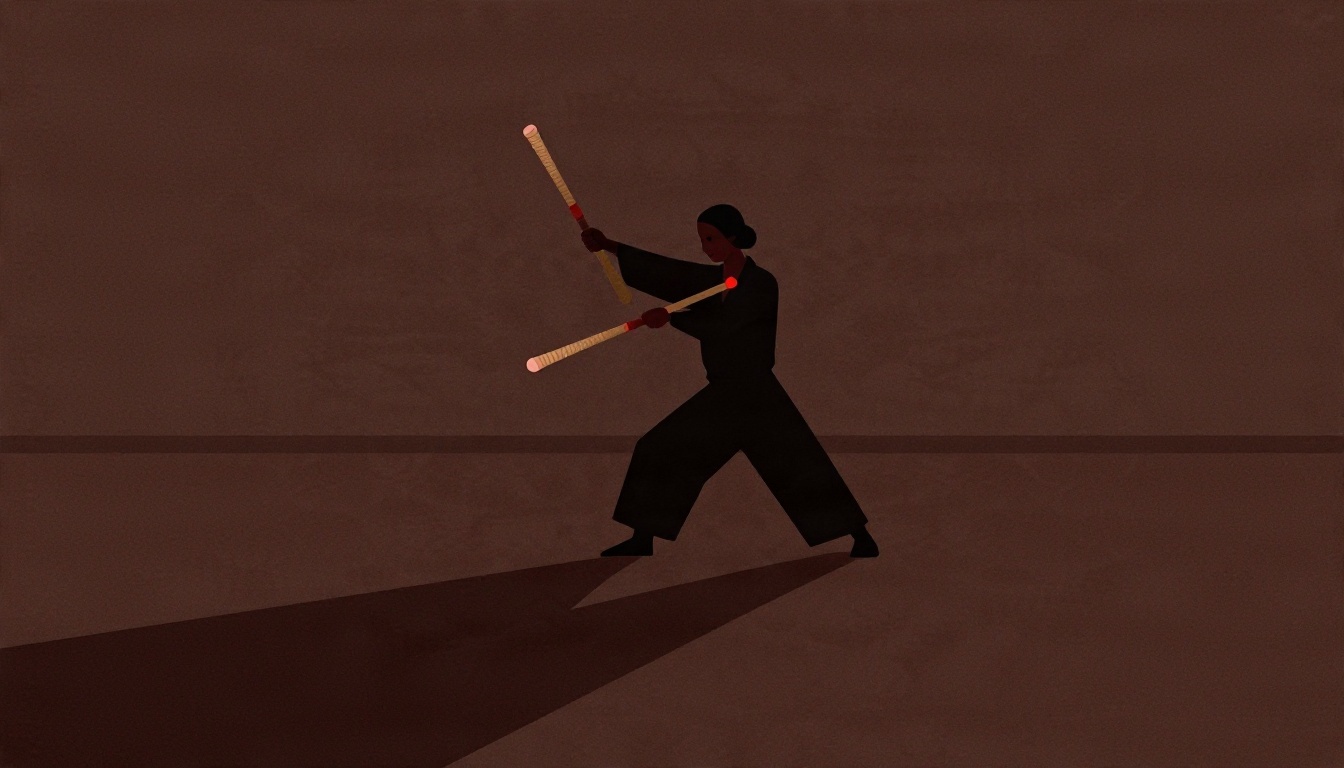
According to the sources, what is one documented benefit of Filipino martial arts stick drills?
Select one answer.
Why your reaction time stalls
If your reaction time has plateaued, the problem is usually not effort — it's the type of training. Generic reaction apps and cone drills train your eyes and hands in isolation. Filipino martial arts (FMA) stick drills, known as Arnis, Kali, or Eskrima, train them together under a moving rhythm, which is closer to how reaction actually works in sparring or competition.
FMA training with sticks, knives, and empty hands is used specifically to enhance hand-eye coordination, and the flowing movements are credited with improving reaction time and muscle memory (Tiger Muay Thai Bohol). Kali stick training is also described as helping your body react faster and more accurately because your hands, eyes, and feet learn to work together (Sixth Sense MMA).
What the research says about martial arts and reaction time
Reaction time is trainable, and martial artists tend to outperform non-practitioners on reaction tasks. A 2002 review by Mori, cited widely in reaction-time literature, notes that karate athletes showed faster reaction times than novices for both verbal and action response modes (ScienceDirect). More recent work by Rodrigues (2025) found that Taekwondo practitioners exhibited superior simple reaction time across all sensory pathways compared to physically inactive individuals.
The practical takeaway: consistent martial arts practice changes how fast you perceive and respond. Stick drills are one of the most efficient ways to load that adaptation because they combine visual tracking, grip changes, footwork, and rhythm in a single drill.
The core drills to start with
You do not need a formal gym to begin. A pair of rattan sticks (or padded sticks for safety) and a clear space are enough.
1. Sinawali (weaving patterns)
Sinawali is the signature double-stick weaving pattern in FMA. It trains both hands to strike and defend in alternating rhythm, which forces your brain to switch attention rapidly. Start slow, then increase speed only when the pattern stays clean.
2. Single-stick striking and blocking
A partner feeds slow strikes while you block and counter. This is the most direct reaction-time drill because you must read the incoming angle and respond. Keep the feed unpredictable but controlled.
3. Stick flow and footwork
Flow drills combine strikes, disarms, and dynamic footwork. Regular practice of Eskrima stick flow drills is credited with improving coordination, reaction time, and stick control. Add lateral movement so your feet are part of the reaction, not just your hands.
4. Numbering and call-out drills
Assign numbers to strike angles. A partner calls numbers in random order and you strike or block accordingly. This builds choice reaction time — the kind that matters when an opponent commits to an attack.
A simple weekly plan
- Day 1: 10 minutes sinawali, slow to moderate speed. Focus on clean rhythm.
- Day 2: 10 minutes single-stick block-and-counter with a partner or wall feed.
- Day 3: 10 minutes flow drill with footwork. Add lateral steps.
- Day 4: 10 minutes number call-out drill. Randomize the calls.
- Day 5: Rest or light shadow drilling.
Keep sessions short and consistent. Reaction time improves through repeated exposure, not marathon sessions.
Common mistakes that slow progress
- Going too fast too soon. Speed hides sloppy mechanics. Clean first, fast second.
- Ignoring footwork. Reaction is full-body. If your feet are static, you are only training half the skill.
- Only training one hand. FMA is built on ambidexterity. Train both sides equally.
- No unpredictability. Scripted drills build coordination, but random feeds build reaction. Use both.
How to measure progress
Track a simple metric: how many clean blocks you land out of 20 random feeds. Re-test every two weeks. You can also use a reaction-time app as a baseline, but remember that stick drills train a broader skill set than a screen tap.
Safety notes
Use padded sticks when starting partner drills. Wear eye protection. Keep the feed speed controlled until both partners are comfortable. FMA is a contact art, and controlled progression prevents injury.
How the Featured Expert Can Help
Ashborn Syndicate blends martial arts training, esports competition, and original dark fantasy storytelling. Its fitness programs are invite-only, creating an exclusive community for those who want to train with a narrative-driven approach. The brand also publishes a dark fantasy saga tied directly to its identity. You can learn more at ashbornsyndicate.com.
Quick quiz
Test your understanding of what the research and FMA sources say about stick drills and reaction time.
Question: According to the sources, what is one documented benefit of Filipino martial arts stick drills?
- A) They replace all other forms of cardio training
- B) They improve hand-eye coordination and reaction time
- C) They only work for advanced martial artists
Correct answer: B) They improve hand-eye coordination and reaction time.