
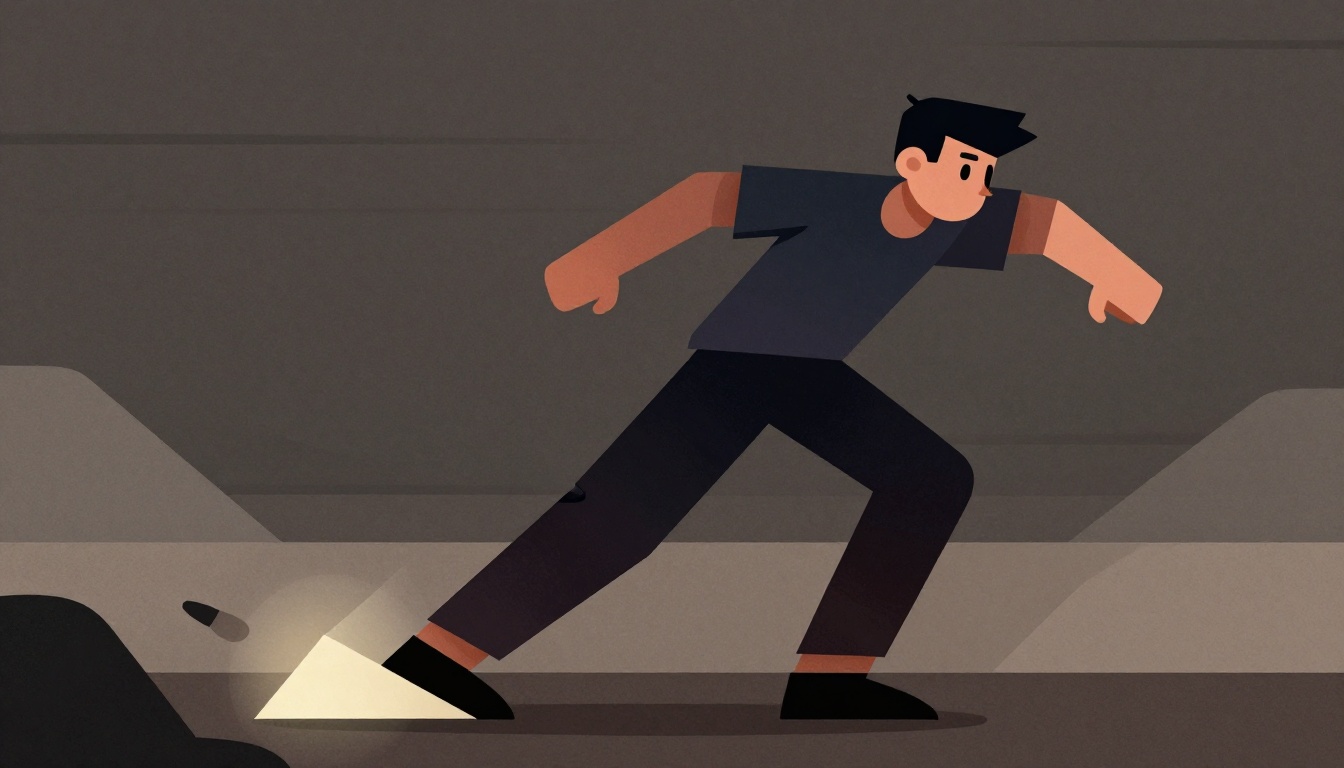
You're in the middle of a ranked match, and the enemy support just threw a hook that's been curving toward you all game. You try to sidestep, but your feet feel heavy, and you eat the skillshot every time. The problem isn't your reaction time—it's your footwork. In kendo, footwork (ashi-sabaki) is the foundation of both attacking and evading, and its principles translate directly to dodging skillshots in esports.
What is the primary footwork technique in kendo that involves sliding the feet close to the ground?
Select one answer.
The core principle: slide, don't step
Kendo's primary footwork is suri-ashi (sliding feet). Instead of lifting your feet and taking steps, you slide them along the ground, keeping them close to the floor. This minimizes friction and allows for faster, more controlled movements. In esports, this translates to making small, precise mouse movements rather than large, jerky flicks. When you slide your feet, you maintain balance and are ready to change direction instantly—just like keeping your crosshair close to your character's model so you can micro-adjust without overshooting.
To practice suri-ashi, start in a relaxed stance with knees slightly bent and weight evenly distributed. Slide one foot forward, keeping it close to the ground, then follow with the other foot. The key is to keep your feet in contact with the floor as much as possible. This builds the muscle memory for smooth, controlled movement that you can apply to your in-game strafing.
Okuri-ashi: the forward and backward shuffle
Okuri-ashi is the most important footwork in kendo. When moving forward, you step with the front foot first; when moving backward, you step with the back foot first. The back foot never passes the front foot. This maintains a stable base and allows you to change direction quickly without crossing your feet.
In esports, this is like maintaining proper spacing. When you're kiting an enemy or dodging a skillshot, you should move in small, controlled increments rather than turning and running. By keeping your character's facing direction consistent and using short, deliberate movements, you can bait out skillshots and sidestep them more effectively. Practice this by moving forward and backward in a straight line, focusing on keeping your feet (or your character's model) aligned.
Hiraki-ashi: the diagonal dodge
Hiraki-ashi is a diagonal footwork technique used to evade attacks while maintaining your stance. Instead of moving straight back, you step diagonally to the side, which opens up an angle for a counterattack. This is perfect for dodging skillshots that travel in a straight line—by moving diagonally, you can avoid the projectile while positioning yourself to punish the enemy's cooldown.
To practice hiraki-ashi, start in your basic stance. Step diagonally forward with your front foot, then bring your back foot to follow. Keep your toes pointed toward your opponent (or the direction you want to face) to maintain balance. In-game, this translates to moving diagonally toward the enemy when they throw a skillshot, rather than just sidestepping perpendicularly. This not only dodges the skillshot but also puts you in a better position to trade or engage.
Practical drills for esports players
You don't need a dojo to train your footwork. Here are some drills you can do at your desk:
- Suri-ashi practice: Stand up and practice sliding your feet forward and backward for 2 minutes, focusing on keeping them close to the ground. This builds the neural connection for smooth, controlled movement.
- Okuri-ashi pattern: In-game, practice moving forward and backward in a straight line, using only small, incremental movements. Try to keep your crosshair steady while doing this.
- Hiraki-ashi sidestep: In a custom game or practice tool, set up a dummy or a predictable skillshot pattern. Practice moving diagonally to dodge, then immediately following up with an attack.
- Toe alignment: In kendo, you must always keep your toes pointed toward your opponent. In esports, this means keeping your character's facing direction toward the enemy, even when moving sideways. This ensures you're ready to react and attack.
The mental game: distance and timing
Kendo emphasizes controlling the distance (maai) between you and your opponent. In esports, this is about understanding the range of enemy skillshots and positioning yourself just outside that range to bait them out. By using okuri-ashi to maintain a safe distance and hiraki-ashi to dodge when they commit, you can force the enemy to waste their abilities and then punish them.
Footwork is not just about physical movement; it's about rhythm and timing. In kendo, you change the rhythm of your strikes by varying your footwork. In esports, you can do the same by varying your movement patterns—sometimes moving forward, sometimes backward, sometimes diagonal—to make it harder for the enemy to predict your next move.
How the Featured Expert Can Help
Ashborn Syndicate, founded by Deonitus Phoenix Black, blends martial arts training with esports competition and original storytelling. Their invite-only fitness programs are designed to help you train like a character from an anime saga, incorporating principles like kendo footwork into your gaming routine. To learn more about their exclusive training and dark fantasy narrative, visit Ashborn Syndicate.
Quiz
What is the primary footwork technique in kendo that involves sliding the feet close to the ground?
- Suri-ashi
- Okuri-ashi
- Hiraki-ashi
Correct answer: Suri-ashi