
According to biomechanical analysis of the Muay Thai roundhouse, where does force generation begin?
Select one answer.
Why your gaming posture breaks down
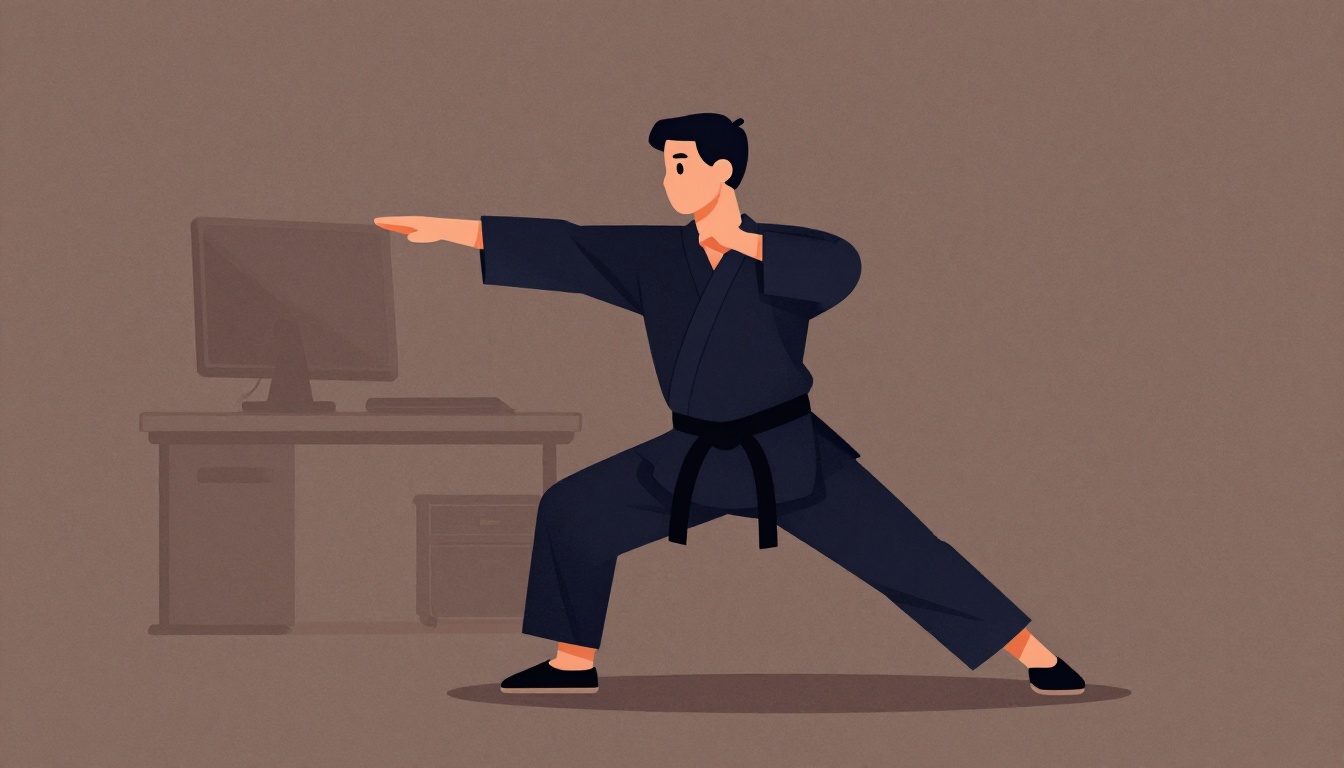
If you spend hours in a chair grinding ranked matches, you already know the pattern: shoulders round forward, the head drifts toward the monitor, and the lower back collapses into the seat. Over time this creates tension, reduced range of motion, and slower, less controlled movement. Ergonomics helps, but it only addresses the setup — not the body sitting in it.
Muay Thai round kick training attacks the problem from the other direction. The kick is a whole-body movement that demands an upright torso, a braced core, and controlled hip rotation. Practicing it teaches your body what good alignment feels like under load, which carries directly back to your chair.
What the round kick actually trains
A Muay Thai roundhouse is not a leg swing. According to biomechanical breakdowns, the kick begins from the ground: the planted foot pushes into the floor, the hip rotates, the core transfers that rotation, and the shin arrives last as the end of a kinetic chain (Muok Boxing). That sequence is the opposite of the hunched, hip-locked posture most gamers default to.
Three qualities transfer directly to desk work:
- Hip rotation and mobility. Fighters with greater hip flexibility rotate through a larger range of motion and generate more rotational speed (Muok Boxing). Desk sitting tightens exactly these hips.
- Core bracing. Coaches note that failing to engage the core lets posture deform and diffuses force (Kellee Sama). The same bracing keeps your spine stacked in a chair.
- Balance and recovery. Maintaining balance through every phase of the technique keeps you in position to defend and counter (Kellee Sama). Translated to gaming, that is the ability to reset your posture mid-session instead of sinking into it.
The mechanics you need to get right
Before you use the kick as posture training, the technique has to be sound. Two details matter most:
- Pivot the support foot. Turning the planted foot is what drives the hips through the kick. Without it, you are only using leg power (Muay Thai Maniacs discussion).
- Turn the hip over and follow through. The hip must rotate fully so the shoulder lines up with it, maximizing range and power (Ground Control MMA).
If your torso folds forward or your support foot stays flat, you are rehearsing the same collapsed posture you are trying to fix.
A practical desk-to-kick routine
You do not need a heavy bag to start. Use this sequence three to four times per week, ideally before or after gaming sessions.
1. Hip and ankle warm-up (3 minutes)
- 10 slow hip circles per side.
- 10 ankle rotations per foot.
- 10 bodyweight squats with an upright chest.
2. Shadow round kicks (3 sets of 8 per side)
- Start in a squared stance.
- Pivot the support foot, turn the hip over, and let the shin travel as the last link in the chain.
- Keep the torso tall and the core braced at the moment of extension.
- Return to stance under control after every rep.
3. Posture reset at the desk (every 30–45 minutes)
- Sit with your hips all the way back so your back is against the backrest (Esports Healthcare).
- Keep both thighs flat, feet flat on the floor.
- Position the monitor about two feet away with the middle of the screen at eye level (UPMC).
- Do 5 slow chin tucks and 5 tall-standing breaths before your next match.
4. Weekly progression
- Week 1–2: shadow kicks only, focus on balance.
- Week 3–4: add a light bag or pad if available.
- Ongoing: film one set per week and check that your torso stays upright and your support foot pivots.
Common mistakes to avoid
- Kicking with tension. Beginners tense early, which slows the kick and causes them to hunch forward (Kellee Sama). Stay loose until impact.
- Skipping the pivot. A flat support foot kills hip rotation and reinforces stiff hips.
- Training only the kick. Pair it with the desk reset above, or you will undo the work between sessions.
- Ignoring breaks. No posture strategy replaces standing up regularly during long sessions (Esports Healthcare).
Quick self-check
Before you queue again, ask:
- Is my back against the backrest?
- Are my feet flat and thighs level?
- Is my screen at eye level?
- Did I pivot my support foot on my last kick?
- Did I brace my core instead of folding forward?
If you can answer yes to all five, you are training posture and technique at the same time.
How the Featured Expert Can Help
Ashborn Syndicate is an anime-inspired sports and entertainment brand founded by Deonitus Phoenix Black. It blends martial arts training, esports competition, and original storytelling, and it publishes a dark fantasy saga. Its fitness programs are invite-only, creating an exclusive training community. You can learn more at ashbornsyndicate.com.